
What does OSHA actually require for handwashing?
Two different rules apply depending on the work. General sanitation for construction crews falls under OSHA 1926.51(c), which sets toilet ratios by crew size: one facility for 20 workers or fewer, then one toilet and one urinal per 40 workers up to 200, then per 50 after that. That rule covers toilets, not sinks specifically. Washing facilities become mandatory under OSHA 1926.51(f)(1) once employees are applying paint, coatings, herbicides or insecticides, or working around other contaminants. If your Ann Arbor crew is doing general framing or roofing with no chemical exposure, that clause does not apply, but 29 CFR 1910.141(d)(2) still governs any washing station you do provide: soap and a way to dry hands, always. Hand sanitizer alone does not satisfy it. We hear this mixed up constantly on our construction site services calls, so it is worth getting the distinction right before an inspector does it for you.
Farm operations in Washtenaw County fall under a separate rule. OSHA 1928.110 requires potable water, toilets and handwashing for hand-labor employees, at a ratio of one facility per 20 workers, and it has to sit within a quarter mile walk of where people are working. That is a different standard than a general contractor uses, and it matters for anyone running farm and agricultural restrooms in the townships around Ann Arbor. Potable water itself is a separate baseline requirement under OSHA 1926.51(a)(1), regardless of which washing rule applies on top of it.
Where should a handwashing station go on site?
Put it next to the toilets, not across the lot. Workers skip handwashing when it is inconvenient, and that defeats the point of having it at all. On a typical Ann Arbor build site we pair a handwashing station rental directly beside each cluster of standard porta potty rental units, close enough that nobody has to make a special trip. If the site is spread out, like a subdivision under construction or a multi-acre commercial pour, plan on more than one washing point rather than one central station everyone has to detour to.
Ground stability matters too. ADA Standards section 302.1 calls for surfaces that are stable, firm and slip resistant, and that is good practice even where ADA does not technically apply, because a station sinking into mud after a Michigan spring thaw does nobody any good. If your project needs an ADA accessible porta potty nearby, ADA Standards section 213.2 says at least 5 percent of clustered units must be accessible, with a minimum of one, and the accessible unit needs a 60 inch turning circle under section 304.3.1. Keep the accessible washing point on that same firm, level pad.
How many handwashing stations does a crew need?
Match it to your worker count and your toilet count, not a flat guess. ANSI/PSAI Z4.3 sets the baseline service interval at one visit per week for up to 10 users over a 40 hour week, and that same rough per-10-person logic is a reasonable starting point for handwashing capacity too, though it is a service standard, not a headcount formula. For crews near the 20-worker threshold under OSHA 1926.51(c), one station by the toilet bank usually covers it. Past 40 or 50 workers, split the crew across two zones with a station in each. Our porta potty placement guide covers the same logic for toilet clusters, and it applies just as well to sink placement. If you are unsure how many units your Ann Arbor site needs overall, our how many porta potties do I need page walks through the math by crew size and shift length.
Do events in Ann Arbor need handwashing stations too?
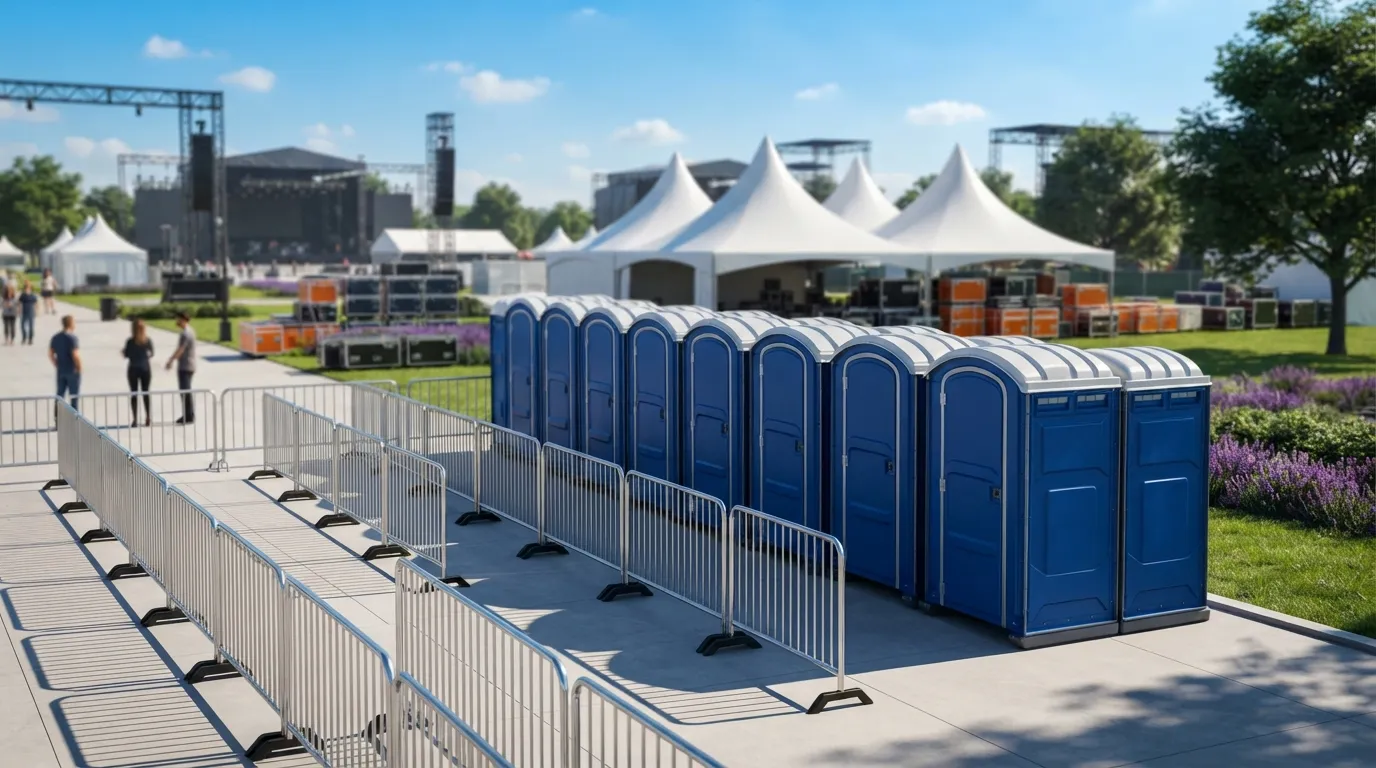
Yes, and food vendors make it non-negotiable. Any event serving food should have a handwashing station within a short walk of the vendor area, separate from restroom units, because you do not want a line at the toilet sink doubling as the line for food prep hygiene. We set these up for wedding restroom rental clients, festival restroom rental bookings, and county fair setups alike. A portable sink rental with fresh water and soap dispensers handles this cleanly, and for larger events we pair it with a full restroom trailer rental so guests are not choosing between a trailer sink and an outdoor station. If your event is smaller and budget-driven, a hand sanitizer station rental can supplement but should not replace a real sink, per 29 CFR 1910.141(d)(2).
Ann Arbor sits close enough to several communities that we route stations out to job sites in Ypsilanti, 6.4 miles east, and Pittsfield, 6.1 miles south, on the same delivery run. Scio is 6.6 miles west. For anyone comparing setups across service areas, the requirements do not change with the zip code, only the drive time.
How much does a handwashing station rental cost?
Pricing depends on the unit and rental length, similar to our porta potty rental cost breakdown. A delivery fee typically runs 100 to 150 dollars for a single day, with weekly delivery often landing lower per visit than repeated daily trips. Ask for a quote matched to your Ann Arbor site specifics.
Does hand sanitizer satisfy OSHA requirements?
No. 29 CFR 1910.141(d)(2) requires soap and towels or a hand drying device at washing facilities. Sanitizer can supplement a station between services, especially at events, but it cannot replace the sink itself on a jobsite subject to this rule.
Can I rent a handwashing station without a porta potty?
Yes. Some Ann Arbor kitchens, food trucks, and small job sites just need a portable sink rental on its own. We deliver them separately from restroom units whenever that is all a site requires.
How often are handwashing stations serviced?
Service frequency follows the same logic covered in our how often are porta potties cleaned page: usage and headcount drive the schedule. ANSI/PSAI Z4.3 sets a weekly baseline for up to 10 users across a 40 hour week.
Are handwashing stations required for home renovation projects?
If contamination exposure exists, such as paint or coatings work, OSHA 1926.51(f)(1) applies. Otherwise 29 CFR 1910.141(d)(2) still governs any station you provide. See our home renovation porta potty page for pairing options.
Next step
Get a delivery date
Tell us the address, the dates and the headcount. We size the order and confirm the route.