How many restrooms does a festival need?
Start with headcount and hours, then work backward. A rough industry baseline from ANSI/PSAI Z4.3 assumes one service visit per week covers 10 users over a 40-hour week, which tells you fast why a one-day festival with thousands of attendees needs a very different ratio than a construction crew. Festivals compress that same usage into 8 or 10 hours, so Ann Arbor Porta Pros scales unit counts around peak-hour attendance, not average daily traffic. Beer tents push demand higher. So does a headliner set that ends and sends 1,500 people toward the exits at once.
For general layout planning, our porta potty placement guide walks through spacing near stages and food vendors. If your event draws workers as well as attendees, staff facilities may fall under OSHA 1926.51(c), which sets ratios for outdoor and construction-adjacent work areas separately from public guest counts. Mixing crew sanitation with public sanitation in one small cluster usually backfires. We plan them as two separate systems even on the same field.
Accessibility isn't optional on public event grounds. At least 5 percent of clustered units need to meet accessible standards under ADA Standards 213.2, and the accessible unit itself needs a 60 inch turning circle inside per ADA Standards section 304.3.1. We stage those units near the accessible parking or drop-off point, not tucked behind the vendor row, because ADA restroom requirements exist to make the units usable, not just present.
What restroom options work for a festival?
Straight standard units handle most general admission crowds fine, and they rent by the event at rates that scale with quantity. For sponsor areas, VIP sections or a wedding-adjacent festival tier, a deluxe flushable porta potty or a full restroom trailer rental reads a lot better next to a stage than a bank of plain units. An 8 stall restroom trailer can anchor a VIP zone while 4 stall or 2 stall trailers cover smaller staff or artist areas.
Multi-day festivals change the math again. A weekend rental runs differently than a single day, and our restroom trailer rental cost page breaks down where trailers make sense versus standard units stacked in higher volume. Handwashing matters here too. Under 29 CFR 1910.141(d)(2), washing stations need actual soap and towels or a hand-drying device, not sanitizer alone, so we pair unit clusters with real handwashing station rental setups rather than gel dispensers bolted to a fence post.
Food vendors add another layer. If a vendor area runs grills, fryers or cleanup chemicals, a portable sink rental near that zone keeps hands clean between service and cash handling, separate from guest restroom lines entirely.
| unit | duration | low | typical | high |
|---|---|---|---|---|
| standard | event | 200 | 400 | 800 |
| ada | weekend | 199 | 240 | 300 |
| deluxe | week | 150 | 250 | 290 |
| trailer | event | 2499 | 3500 | 3899 |
Why does festival placement matter more than count?
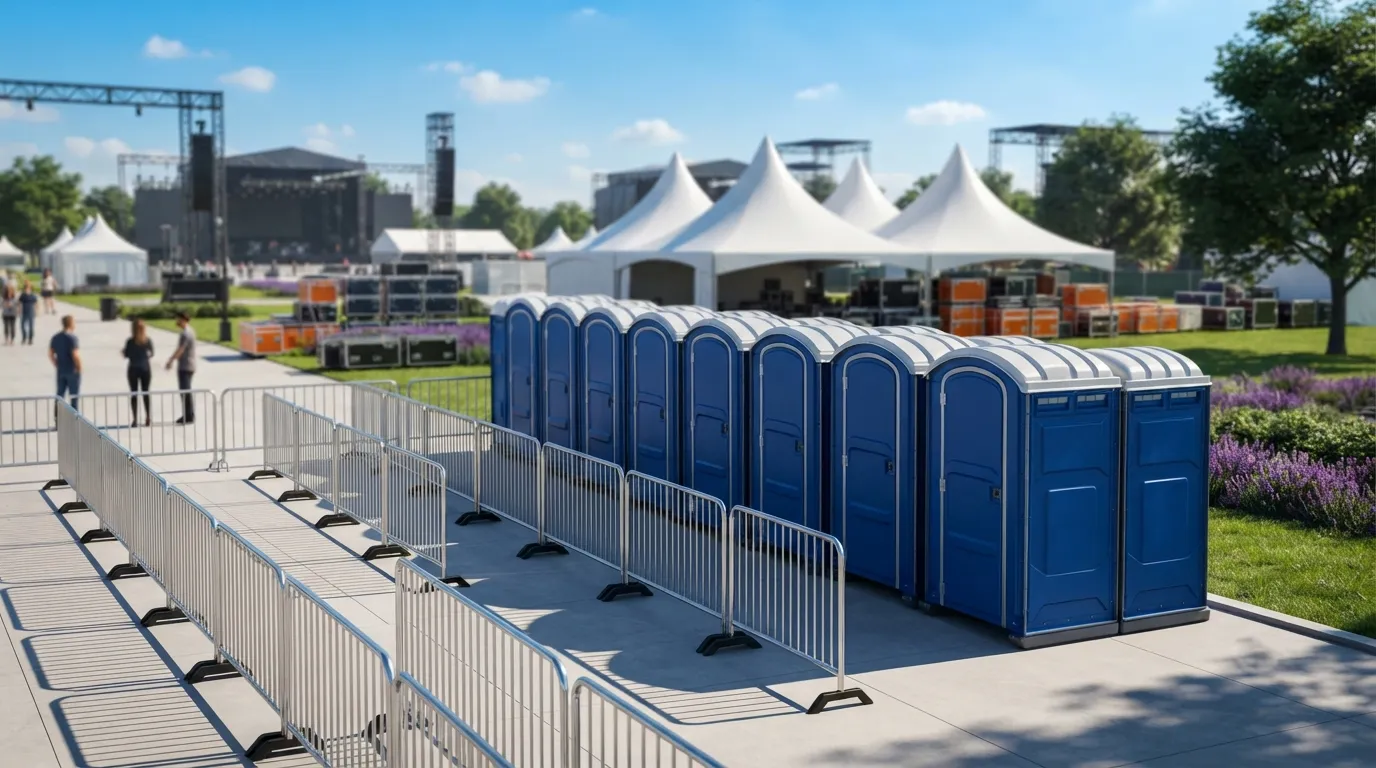
Placement decides whether your unit count actually works. Ground under every unit needs to be stable and slip resistant per ADA Standards section 302.1, which rules out soft turf after rain without matting or gravel pads. Delivery trucks need roughly 60 feet of straight clearance behind the vehicle to set units without dragging them across a field by hand, so gate and access road width matters before you finalize a site map. Ann Arbor festival grounds with narrow service entrances need that clearance checked early, not the morning of load-in.
Accessible routes to each cluster need a 36 inch minimum clear width under ADA Standards section 403.5.1, and any accessible unit door needs a 32 inch clear opening per ADA Standards section 404.2.3. Stack these requirements against food truck rows, generator cords and fencing lines and you can see why placement takes a site walk, not a floor plan sketched from a laptop. If your event runs temporary fence rental or crowd control barrier rental to manage lines, restroom clusters need to sit inside that perimeter, with clear sightlines for staff.
Multi-day events in Ann Arbor also need lighting after dark near restroom rows. A light tower rental placed near each cluster keeps night access safe and cuts down on the complaints that come from a dark, unfamiliar path to a portable unit at 11pm. For events pulling power from a generator or a nearby building, a temporary power pole may need to run before lighting or trailer hookups go in. Compare this against our event restroom rental and concert restroom rental pages if your festival leans closer to one of those formats.
How far in advance should I book festival restrooms?
Book as soon as your date and headcount are set, ideally weeks out for anything over 500 attendees. Trailer availability tightens fastest. Standard units are easier to add late, but accessible units and trailers need lead time for routing trucks and confirming ground access at the venue.
Do festivals need a permit for portable restrooms?
Placement in a public right of way or park needs confirming with the City of Ann Arbor before delivery. Rules vary by venue and by whether the event sits on public or private ground, so check with the city directly rather than assuming a past event's approval carries over.
Can I mix standard units and a restroom trailer at one event?
Yes, and it's common. Many festivals put standard units in high-traffic general admission zones and reserve a trailer for VIP, sponsor or backstage areas. It keeps line pressure off the nicer units while still covering total headcount.
What happens if a festival runs over its planned hours?
Call ahead if you expect an extension. Service intervals and pickup times get scheduled around your stated hours, and running long without notice can mean units sit full past your last set. Ann Arbor Porta Pros can usually adjust with enough notice.
How close should restrooms be to the main stage?
Close enough to reach in a few minutes without crossing the whole grounds, but far enough that lines don't block sightlines or emergency lanes. A site walk before load-in settles this faster than guessing from a map.
Next step
Get a delivery date
Tell us the address, the dates and the headcount. We size the order and confirm the route.